Search This Blog

Showing posts with label Variables. Show all posts

Thursday, January 4, 2024

Function in C Part 4: Recursion Function, Nested Functions


Recursion Function

  • A function that calls itself is known as a recursive function. And, this technique is known as recursion.


  • The recursion continues until some condition is met to prevent it.

  • To prevent infinite recursion, if...else statement (or similar approach) can be used where one branch makes the recursive call, and other doesn't.


Example: Sum of  Natural Numbers Using Recursion


#include <stdio.h>

int sum(int n);


int main() {

    int number, result;


    printf("Enter a positive integer: ");

    scanf("%d", &number);


    result = sum(number);


    printf("sum = %d", result);

    return 0;

}


int sum(int n) {

    if (n != 0)

        // sum() function calls itself

        return n + sum(n-1); 

    else

        return n;

}

Output:

Enter a positive integer: 3

sum = 6


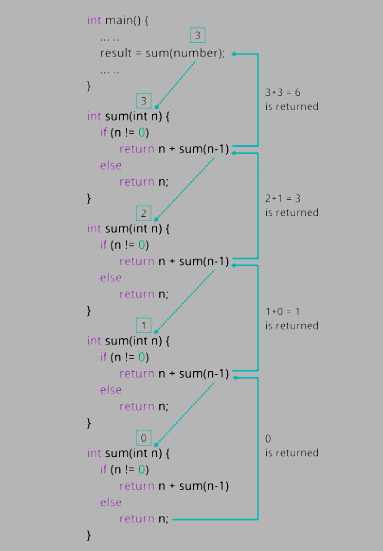
Initially, the sum() is called from the main() function with number passed as an argument.

Suppose, the value of n inside sum() is 3 initially. During the next function call, 2 is passed to the sum() function. This process continues until n is equal to 0.

When n is equal to 0, the if condition fails and the else part is executed returning the sum of integers ultimately to the main()function.


Nested Functions

GNU C provides several language features not found in ISO standard C.

nested function is a function defined inside another function. Nested functions are supported as an extension in GNU C

The nested function’s name is local to the block where it is defined. For example, here we define a nested function named square, and call it twice:

#include <stdio.h>


int foo (int a, int b);


int main() {


    int r;

    r =foo(2,3);

    printf("result :: %d", r);


    return 0;

}

int foo (int a, int b)

{

  int square (int z) { return z * z; }


  return square (a) + square(b);

}

Output 

result :: 13


Function in C Part 3:Scope of Variables:


Scope of Variables:

  • A scope is a region of the program, and the scope of variables refers to the area of the program where the variables can be accessed after its declaration.

  • The scope of the variable is simply lifetime of a variable. It is block of code under which a variable is applicable or alive. 

  • There are three places where variables you can declare variable programming language:

    1. Inside a function or a block: Local variables

    2. Outside of all functions: Global variables

    3. In the definition of function parameters: Formal parameters

Local Variables:

  • Variables that are declared inside a function or block are called local variables. 

  • The local variables exist only inside the block in which it is declared.

  • The local variable exists until the block of the function is under execution. After that, it will be destroyed automatically.

  • Example of  Local Variable 

public int add(){ 

int a =4; 

int b=5; 

return a+b; 

Here, 'a' and 'b' are local variables

#include<stdio.h>

int main()

{

    int a = 100;

    {

        int a = 10;  

        printf("Inner a = %d\n", a);

    }

    printf("Outer a = %d\n", a);

    return 0;

}


Output:

Inner a = 10

Outer a = 100

Global Variables :

  • Global variables are defined outside a function, usually on top of the program (Global declaration section).

  • It has a global scope means it holds its value throughout the lifetime of the program.

  • Any function can access and modify global variables. That is, a global variable is available for use throughout your entire program after its declaration. 

  • Global variables are automatically initialized to 0 at the time of declaration. 

  • Example:

int a =4; int b=5; 

public int add()

return a+b;

 }

 Here, 'a' and 'b' are global variables.

#include<stdio.h>


void func_1();

void func_2();


int a, b = 10;  // declaring and initializing global variables


int main()

{

    printf("Global a = %d\n", a);

    printf("Global b = %d\n\n", b);


    func_1();

    func_2();


    return 0;

}


void func_1()

{

    printf("From func_1() Global a = %d\n", a);

    printf("From func_1() Global b = %d\n\n", b);

}

void func_2()

{

    int a = 5;

    printf("Inside func_2() a = %d\n", a);

}


Output:


Global a = 0

Global b = 10


From func_1() Global a = 0

From func_1() Global b = 10


Inside func_2() a = 5


Function in C Part 4: Recursion Function, Nested Functions

  Recursion Function A function that calls itself is known as a recursive function. And, this technique is known as recursion. The recursion...